
The Policy Exists. That Was Never the Question.
There's a particular moment that housing governance leads will recognise. An investigation, a complaint, or an inspection turns up a decision that shouldn't have been made — and the explanation, once you trace it back, is that the member of staff involved was working from a policy that had been superseded eighteen months earlier.
The policy was updated. It was approved by the right committee. It was saved to the right folder. And it never reached the person who needed it.
This is the central problem of policy management, and it's almost entirely invisible until something goes wrong. Organisations invest heavily in writing policy — consultation, legal review, board approval — and then treat the moment of approval as the finish line. In practice, approval is roughly the halfway point.
The Four Failure Points
Policy management breaks down in reliably similar ways across the sector.
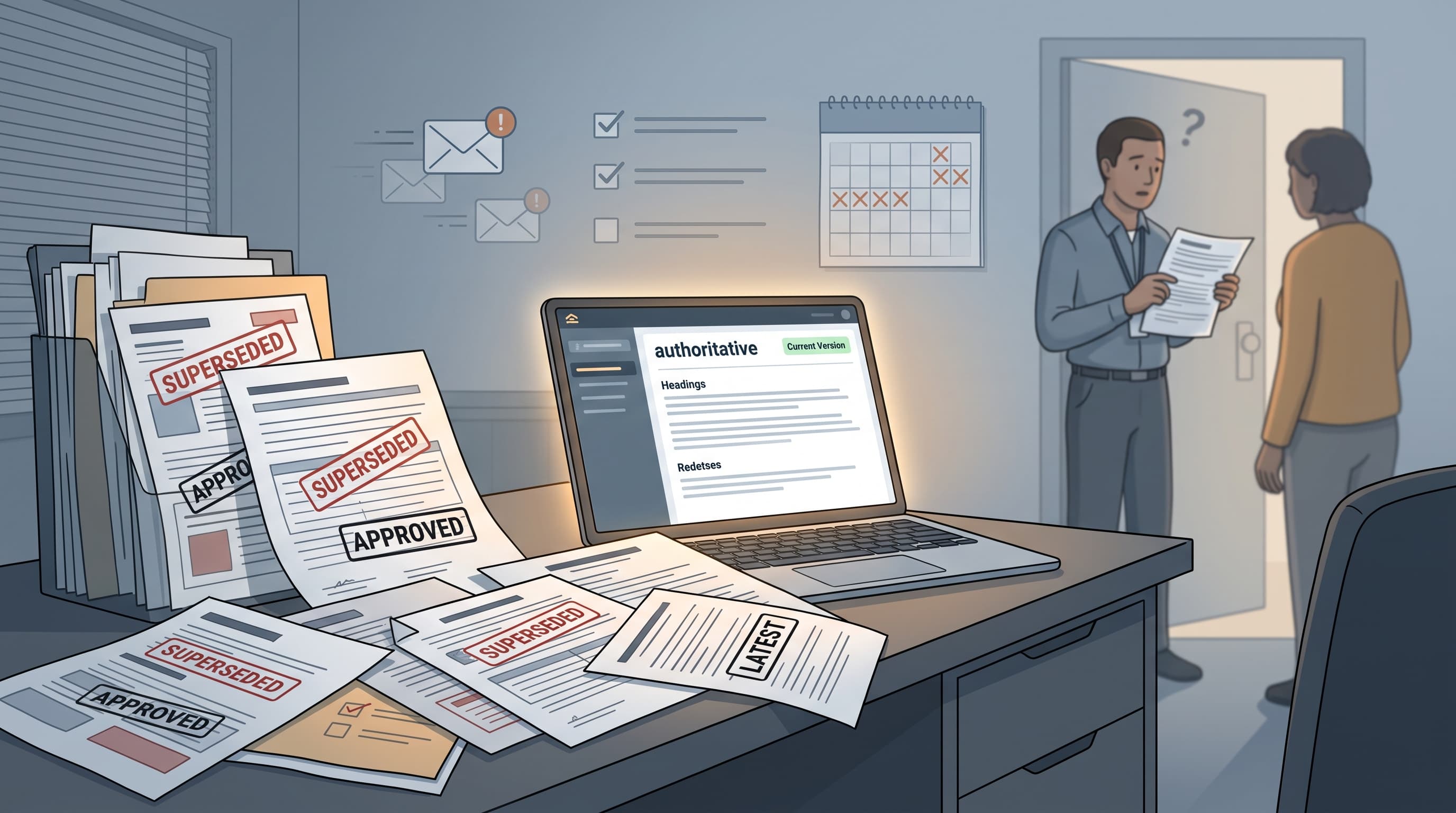
The version problem. A policy exists in a shared drive, in an intranet page, as an attachment in someone's induction email, and as a printout in a folder on a depot wall. When the policy changes, one or two of those get updated. The rest quietly become misinformation.
The distribution problem. The updated policy is published, but publication isn't distribution. Nobody is told. Or everyone is told, in a monthly all-staff email, alongside eleven other items.
The acknowledgement problem. Even where staff are notified, there's no record of who opened it, who read it, and who understood the change. When the regulator asks how you know your frontline teams are working to current policy, "we emailed it out" is not an answer that survives scrutiny.
The review problem. Every policy carries a review date. In most organisations, that date is recorded in the document itself — the one place nobody looks until the review is already overdue. Reviews slip. A policy drifts past its review date, then past a change in legislation, and nobody notices until an auditor does.
Why This Matters More Than It Used To
Under the revised consumer standards, providers are expected to demonstrate not merely that policies exist, but that they are implemented, understood, and effective. The Housing Ombudsman's approach to complaints follows the same logic: findings of maladministration frequently turn less on the absence of a policy than on the failure to follow one.
That's a meaningfully higher bar. It means the evidence you need is no longer the document itself. It's the trail around the document — the approval record, the distribution record, the acknowledgement record, the training linkage, the review history.
Most organisations have the document. Far fewer have the trail.
What a Policy Manager Is Actually For
The term "policy manager" gets used loosely, sometimes to mean little more than a document library with a search box. That's not the useful definition.
A policy management system worth having does five things a shared drive fundamentally cannot.
It enforces a single current version. There is one authoritative copy. Superseded versions are retained for audit but cannot be mistaken for current. Nobody is ever working from a stale PDF because there is no stale PDF to find.
It manages the approval workflow. Drafting, review, consultation, committee approval, and publication are tracked as stages with owners and dates — not reconstructed afterwards from a chain of emails.
It distributes by role and records acknowledgement. When a repairs policy changes, it reaches the repairs teams specifically, and the system records who has confirmed they've read it. Outstanding acknowledgements escalate.
It drives the review cycle actively. Review dates generate work, assigned to a named owner, with escalation when they lapse. The system chases; the governance lead doesn't have to.
It links policy to everything else. A policy connects to the legal obligation it discharges, the risks it mitigates, the procedures that implement it, and the training that supports it. Change one and you can see, immediately, what else is affected.
That last point is the one that separates genuine policy management from expensive filing.
The Frontline Test
Here's a useful diagnostic for any housing organisation.
Pick a policy that changed in the last six months — ideally one with real operational consequences, like the process for handling a damp and mould report. Now find a member of frontline staff and ask them to show you the policy they work to.
Three things can happen. They produce the current version, and you have a functioning system. They produce an old version, and you have a distribution problem. Or they can't produce anything at all and describe what they've been told by a colleague — which is the most common outcome, and the most concerning, because it means your policy framework has been quietly replaced by oral tradition.
Oral tradition is not a defence. It's not evidence. And under the current regulatory regime, it's not a position any provider can afford to be in.
Getting Out of the Hole
Organisations trying to fix this usually start by attempting to rewrite everything at once. That's a mistake — it's a six-month project that produces a beautiful policy set with exactly the same distribution and acknowledgement problems as the old one.
A more effective sequence:
- Establish the authoritative set first. Work out what policies you actually have, which version of each is current, and where the duplicates are. This is unglamorous and usually reveals more than expected.
- Assign role-based ownership. Every policy gets an owner defined by role. Unowned policies are either assigned or retired — there is no third option.
- Fix distribution and acknowledgement before content. A mediocre policy that everyone has read and acknowledged provides more protection than an excellent one nobody has seen.
- Put the review cycle on rails. Automate the prompts and the escalation. Reviews that depend on someone remembering will be missed.
- Then improve the content, prioritised by risk rather than by whichever policy is most enjoyable to rewrite.
The Point
Policy isn't a document. It's the behaviour of the organisation, and the document is only the mechanism for shaping it.
When policy management works, the connection between what the board approved and what happens at someone's front door is short, traceable, and demonstrable. When it doesn't, that connection is a matter of hope — and hope is the thing that shows up in Ombudsman findings.
The good news is that this is a solvable problem, and solving it doesn't require better policies. It requires better plumbing.
Wavio is a unified digital-first platform empowering housing providers and local authorities with integrated governance, compliance, and operational management tools. Find out more about Wavio Policy Manager, or book a demo to see how policy management, legal registers, and risk oversight work together in one place.