
The Tool Is Not the Point — Until It Is
We've argued before that a risk register should be a live management tool rather than a quarterly ritual. That's the easy part to agree with. The harder question is practical: what do you actually run it in?
Most housing providers answer that question by default rather than by decision. The register lives in a spreadsheet because it always has, or in a module of a housing management system that nobody chose for its risk capabilities, or in a general-purpose GRC platform bought for something else and repurposed.
None of those are automatically wrong. But the tool shapes the behaviour, and a register that's painful to update will not be updated. If your risk process is stuck in a quarterly cycle, it's worth asking whether that's a cultural problem or a tooling one. It's often the latter, wearing a cultural disguise.
Where the Spreadsheet Actually Breaks
Spreadsheets get more criticism than they deserve. For a small organisation with fifteen strategic risks and a disciplined company secretary, a well-built spreadsheet is genuinely adequate.
The breaking points are specific rather than general:
- Concurrent ownership. The moment more than two or three people need to update their own risks independently, you're managing merge conflicts by email.
- Movement over time. Boards want to know which risks are moving, not just where they sit. Reconstructing a trend from monthly file copies is possible but nobody does it.
- Linkage. A spreadsheet cell can say "mitigated by fire door inspection programme." It cannot tell you that 12% of that programme is overdue.
- Escalation. Spreadsheets are passive. An action that missed its date last month looks identical to one due next month.
- Assurance evidence. When an inspector asks how a given control is evidenced, the spreadsheet points at a process. Someone still has to go and find the proof.
If none of those are hurting, you don't have a tooling problem yet. If two or more are, the register is likely already less accurate than people believe.
What to Actually Look For
Evaluating risk tooling tends to devolve into feature checklists, most of which are irrelevant. A few capabilities genuinely matter for housing providers.
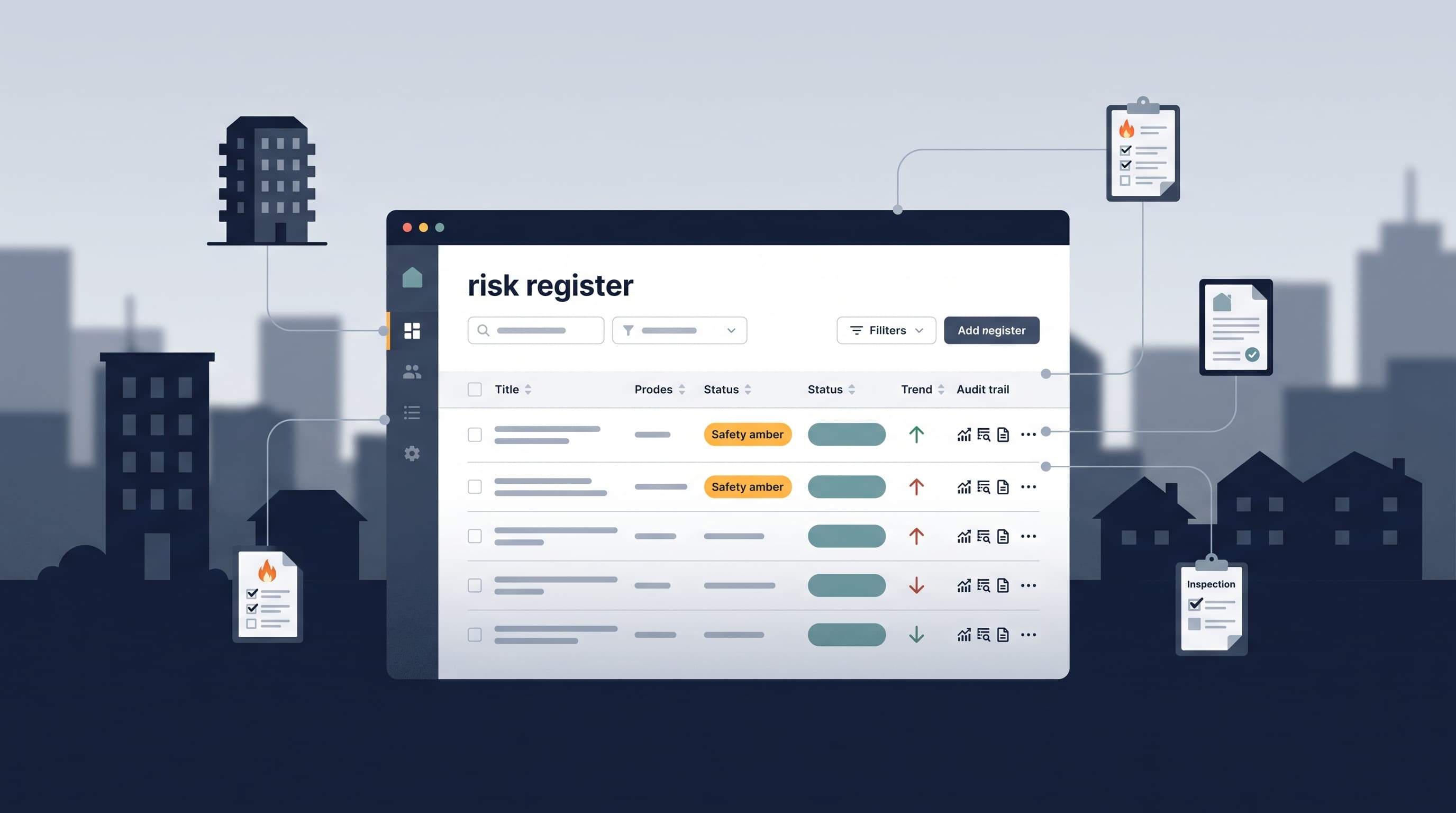
Linkage to operational reality. This is the single biggest differentiator. Can a risk connect to the compliance programmes, inspections, policies, and legal obligations that actually mitigate it — and can you see live status, not a text description? A tool that can't do this produces a register that describes intentions rather than reality.
Inherent, current, and target scoring. You need to show the risk before controls, where it sits now, and where you're trying to get to. Tools that only capture a single current score make it impossible to demonstrate that your controls are doing anything.
Movement tracking as a first-class feature. Score history, direction of travel, and the reason for each change. Boards ask about movement more than absolute position, and reconstructing it manually is where most register processes die.
Role-based ownership with real accountability. Ownership assigned to a role, actions assigned to individuals, escalation when dates slip. The tool should chase people, because governance leads shouldn't have to.
Multi-level registers that roll up. Strategic, operational, and project-level risks in a coherent hierarchy — so an operational risk that's deteriorating can surface upward rather than sitting invisibly in a departmental tab.
Board reporting that generates itself. If someone spends two days a quarter turning the register into slides, the tool has failed. Reporting should be a view of live data, not a manual transformation of it.
A complete audit trail. Who changed what, when, and why. This is unglamorous and it's the thing you'll be most grateful for during an inspection.
What Matters Less Than Vendors Suggest
Some capabilities demo beautifully and deliver little.
Elaborate heat maps. Every tool has one. They're a visualisation of data you already have, and no board has ever made a better decision because the amber was a nicer shade.
Monte Carlo simulation and quantitative modelling. Excellent for financial risk in organisations with the data to support it. For most housing providers, applying probabilistic modelling to a risk scored on a 5×5 matrix by professional judgement is false precision.
Vast risk taxonomy libraries. A pre-loaded catalogue of eight hundred generic risks sounds helpful and mostly produces a bloated register full of entries nobody owns.
AI-generated risk descriptions. The writing was never the hard part. The hard part is honest assessment and follow-through, and no amount of generated prose substitutes for either.
Be similarly cautious about tools that are excellent at risk and nothing else. A standalone risk platform that doesn't connect to your compliance, policy, and legal register data recreates the fragmentation problem in a nicer interface — and adds another login, another data owner, and another integration to maintain.
The Housing-Specific Requirement
Generic enterprise risk tools are built for a world where risk management is a self-contained discipline reporting to an audit committee. Social housing doesn't work that way.
In housing, the strategic risk that keeps a board awake — building safety, damp and mould, complaint handling, data governance — is directly downstream of operational activity happening every day at property level. The risk score is only meaningful if it reflects that activity.
Which means the useful test for any risk tool in this sector is a single question: when the operational picture changes, does the register know?
If a fire risk assessment programme starts slipping, does the associated risk show movement automatically, or does it wait for a human to notice at the next quarterly review? If a policy passes its review date, does the risk it mitigates reflect that? If complaint volumes on a theme are rising, does anything connect that to the relevant risk entry?
Tools that can answer yes turn the register into an early warning system. Tools that can't leave it as a record of what somebody thought last quarter.
A Pragmatic Path
You don't need to procure a platform to make progress. A sensible sequence:
- Fix the register's content first. A migrated bad register is a bad register with better formatting.
- Establish ownership and review cadence in whatever you're using now. If people won't maintain it in a spreadsheet, a new tool won't change that.
- Identify your specific breaking points from the list above — the ones actually causing pain, not the theoretical ones.
- Evaluate against linkage and assurance, not feature count.
- Prefer integrated over standalone unless you have a compelling reason otherwise.
The organisations getting real value from risk management aren't the ones with the most sophisticated tooling. They're the ones whose register is close enough to operational truth that people actually trust it — and act on it.
Wavio is a unified digital-first platform empowering housing providers and local authorities with integrated governance, compliance, and operational management tools. Find out more about Wavio Risk Register, or book a demo to see how risk registers, legal registers, and policy management connect to live operational data.