
The Walk Round That Nobody Can Find Afterwards
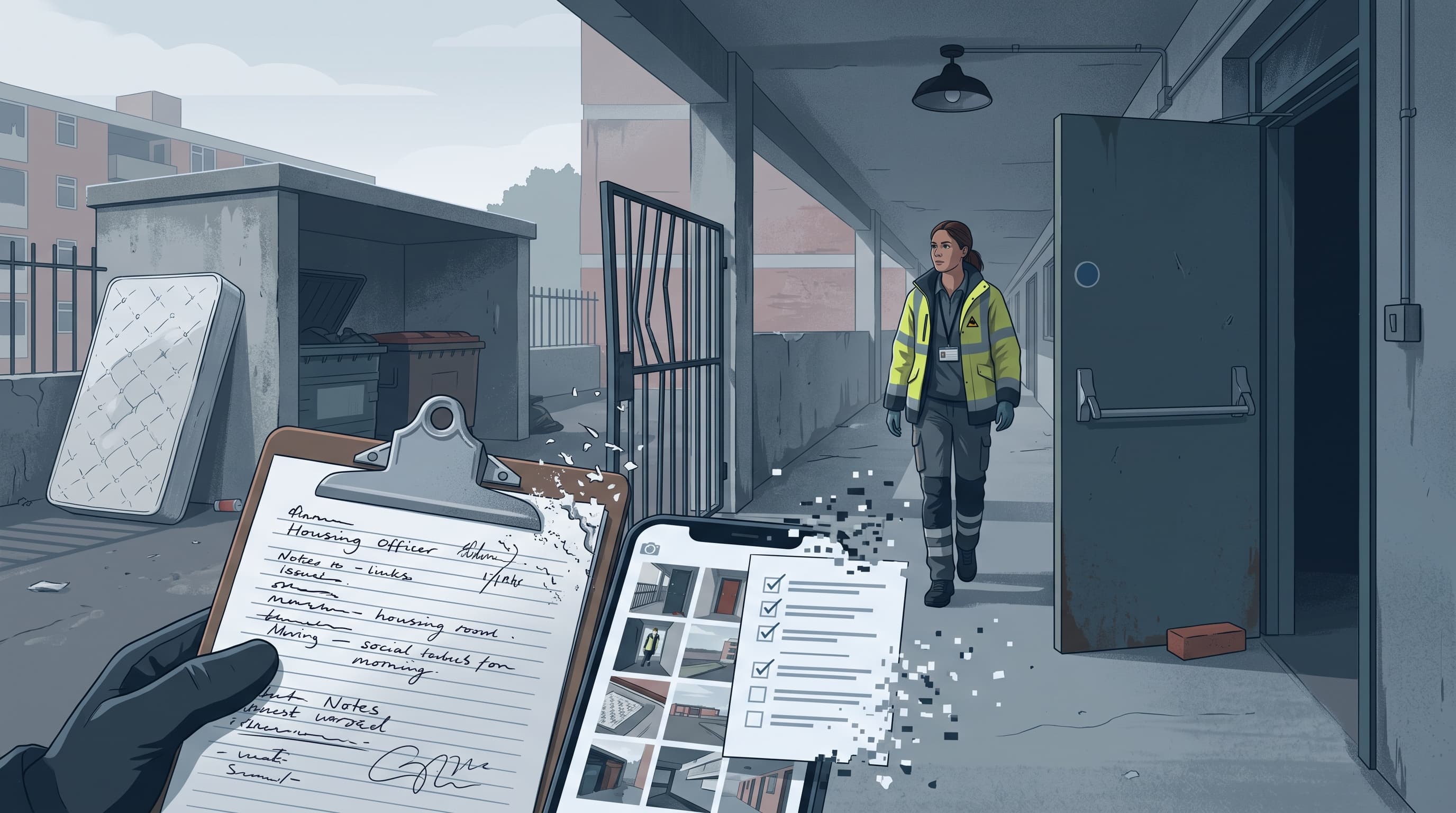
A housing officer walks an estate on a Tuesday morning. She notes a broken gate, a fly-tipped mattress by the bin store, a communal light out on the second landing, and a fire door propped open with a brick. She photographs all four on her phone. She gets back to the office, gets pulled into two tenancy issues and a complaint call, and writes up the inspection on Thursday from memory and a camera roll that now also contains her daughter's sports day.
Three of the four issues get raised. The fire door doesn't — not through carelessness, but because by Thursday it had blurred into a general sense that the block needed attention.
Six weeks later, someone asks whether that block was inspected in the last quarter. The answer is yes. The evidence is a Word document in a folder, the photos are on a personal device, and nobody can say with confidence what was found or what happened next.
This is not an unusual story. It's the normal operating condition of neighbourhood management across a great deal of UK social housing — and it's the gap between doing the work and being able to show you did it.
Neighbourhood Management Has Quietly Become a Regulated Activity
For years, estate management sat slightly outside the compliance conversation. Gas, fire, electrical, water, lifts — those were the "big six" with hard timescales and obvious consequences. Estate inspections were good practice.
That distinction has eroded. The Neighbourhood and Community Standard sets explicit expectations around the condition of communal areas, the handling of anti-social behaviour, and cooperation with partner agencies. The Safety and Quality Standard requires providers to know the condition of their stock — which includes the parts of it nobody lives in. The Transparency, Influence and Accountability Standard expects residents to be able to see what's being done and hold providers to account for it.
All three of those are evidenced primarily through neighbourhood activity. And all three are assessed on the basis of what you can demonstrate, not what you know you did.
The practical consequence: an estate inspection regime that exists in Word documents and personal camera rolls is now a regulatory exposure, not just an operational inefficiency.
Where the Value Leaks
The failure points in neighbourhood management are consistent across organisations, and none of them are about staff effort.
The write-up delay. Time between observation and record is where detail dies. An inspection captured on paper and typed up two days later loses roughly the things that were hardest to notice in the first place.
Photos that go nowhere useful. Images on personal phones aren't part of the record, aren't retained appropriately, and create a genuine data protection question that most providers would rather not examine closely.
Actions without owners. An inspection identifies fifteen issues. Some go to repairs, some to grounds maintenance, some to the tenancy team, some to a contractor. Without a single tracked list, closure becomes a matter of individual diligence and the ones that fall between teams are invisible.
No trend view. The third time a fire door is propped in the same block is a different problem from the first time. If each inspection is a standalone document, that pattern never surfaces — and the underlying cause is never addressed.
The loop stays open with residents. People report an issue, see the officer looking at it, and then hear nothing. The work often gets done. The communication doesn't. Satisfaction scores absorb the difference.
The Lone Working Question
There's a related issue that sits uncomfortably alongside all of this.
Neighbourhood officers work alone, on foot, in unpredictable environments, often visiting properties where there's a known history of aggression. Many organisations manage this with a check-in text to a colleague and an assumption that someone would notice if it stopped arriving.
That's not a system. It's a hope with a phone number attached.
Proper lone worker protection — timed check-ins, escalation when a check-in is missed, location visibility during a visit, a discreet alert — belongs in the same tooling as the inspection itself, because it's the same journey. Asking officers to run a safety app and a separate inspection process is asking them to remember two things while walking into the one situation where they shouldn't have to remember anything.
What Good Actually Looks Like
A neighbourhood management system that earns its place does a small number of things well.
Capture happens on site, on a phone, in the moment. Structured forms, photos attached to the specific issue rather than to a general folder, offline capability for the stairwell with no signal.
Every issue becomes a tracked action with an owner and a due date. Not a paragraph in a report someone has to read and act on — a discrete item that appears in someone's queue and escalates if it doesn't move.
Location and asset linkage is automatic. The issue is attached to the block, the estate, the specific communal area — so patterns aggregate without anyone doing analysis.
Trends surface without being asked for. Repeat issues, deteriorating estates, blocks with rising ASB reports. This is the difference between a record system and a management system.
Compliance-relevant findings route into the compliance process. A propped fire door isn't an estate issue that happens to involve fire safety. It's a fire safety issue that happened to be found on an estate walk, and it should land accordingly.
Lone worker safety is built into the same journey, not bolted on beside it.
Residents can see the outcome. Even a simple loop — reported, actioned, closed — changes the relationship considerably.
The Argument That Actually Lands With Boards
The operational case for better neighbourhood tooling is easy to make and easy to deprioritise, because it competes with things that feel more urgent.
The governance case is harder to ignore. Neighbourhood activity generates a large proportion of the evidence a provider needs for consumer standards assurance, and it's the part most likely to be held in a form that can't be produced on request. When an inspector asks how you know your communal areas are safe and well managed, the answer needs to be a dashboard, not a folder.
There's also a quieter point. Frontline neighbourhood staff are the people most likely to spot a problem before it becomes a complaint, a claim, or a headline. If the system they work in makes it hard to record what they've seen, the organisation is systematically discarding its best early warning signal.
That's not a technology problem. But it does have a technology answer.
Wavio is a unified digital-first platform empowering housing providers and local authorities with integrated governance, compliance, and operational management tools. Find out more about Wavio Neighbourhoods, or book a demo to see how inspections, action tracking, and lone worker protection work in one place.